The U.S. Environmental Protection Agency expects its first lab results from samples taken after the Army's lead azide detonation in Iowa as early as Friday, and it plans more sampling of agricultural ponds in Missouri, the agency said Thursday.
According to an EPA release posted at 8:52 a.m. Thursday, crews collected more than 1,000 samples after Wednesday's blast at the Iowa Army Ammunition Plant in Middletown, Iowa, on top of 1,591 taken beforehand. They went to EPA's Kansas City, Kansas, lab, mobile labs at the site, and private labs.
EPA Administrator Lee Zeldin said in a post on X at 8:59 a.m. Thursday that the lab has "a 24 to 48 hour turnaround projection" and that EPA aimed to finish all sample collection that day. At 9:46 p.m. Wednesday, he had said results would start arriving "over the next 24 to 48 hours." No lab results had been posted as of 2:40 p.m. Thursday.
The release says EPA sampled "every drinking water intake in the pre-detonation plume model" on the day of the blast and would take a second round of drinking water samples Thursday. It doesn't name those intakes or say whether any are in Missouri. "Further sampling in agricultural ponds in Missouri will continue," according to the release, which does not say where.
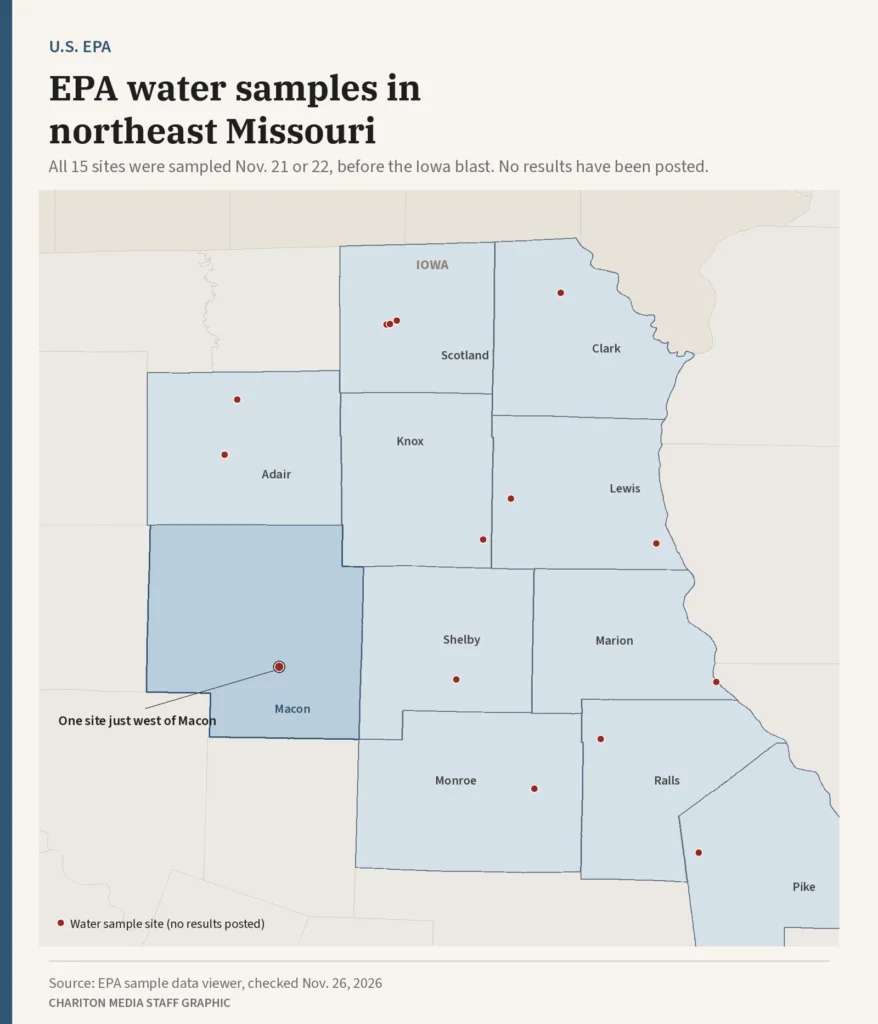
EPA added sampling locations to its public dashboard Thursday, according to its response website. The map shows one Macon County water sample, just west of Macon, taken Nov. 21, four days before the blast. It is one of 15 water locations in 11 northeast Missouri counties, all sampled Nov. 21 or 22. Every water and soil sample on the map predates the detonation, none shows a result, and the tap water and dust layers are marked "Data Pending."
The release also says EPA's real-time Xact air monitors "continue to report, as they have since detonation, zero detection of airborne lead throughout the region." The agency's dashboard data show 21 readings above zero after 9 a.m. Wednesday, the highest 0.0102 micrograms per cubic meter at station AS04 at 10 a.m. Wednesday. Four came at AS04 early Thursday. EPA hasn't explained them. The dashboard lists 32 micrograms per cubic meter as the Department of Energy's short-term air screening level for lead.
From 8 a.m. to 2:17 p.m. Thursday, the four stations logged 22 readings, all zero, compared with 288 in the same hours Wednesday. Two had logged nothing since about 11:18 a.m., as of 2:40 p.m. The dashboard has no readings between 8:40 p.m. Wednesday and 6:28 a.m. Thursday. EPA says its continuous monitors "continue to run" but not why readings are missing.
The Army's newest item on its plant notifications page is a set of maps from 3 p.m. Wednesday. It has posted no sampling results.
The Missouri Department of Natural Resources page still says no detectable lead is headed toward the state. It says the department is monitoring public drinking water systems that use surface water, 10 of them within 100 miles of the site, but it doesn't name them or post results. Department of Health and Senior Services guidance on that page tells concerned residents to keep fresh air intakes closed for 24 to 48 hours after the detonation, a window that ends about 9 a.m. Friday. Gov. Mike Kehoe's office, the health department, and the State Emergency Management Agency have posted nothing new since Wednesday.
The Army detonated the degraded lead azide at about 9 a.m. Wednesday. The Chronicle reported Thursday morning that no soil or water results had been posted a day after the blast. The Army's Tuesday evening model had shown that airborne lead could reach northeast Macon County.
EPA takes sampling requests at 833-649-9624.